Proceedings of the AAAI Conference on Artificial Intelligence 2026
Steering Pretrained Drafters During Speculative Decoding
Abstract
Speculative decoding accelerates language model inference by separating generation into fast drafting and parallel verification. Its main limitation is drafter-verifier misalignment, which limits token acceptance and reduces overall effectiveness. While small drafting heads trained from scratch compensate with speed, they struggle when verification dominates latency or when inputs are out of distribution. In contrast, pretrained drafters, though slower, achieve higher acceptance rates thanks to stronger standalone generation capabilities, making them competitive when drafting latency is negligible relative to verification or communication overhead. In this work, we aim to improve the acceptance rates of pretrained drafters by introducing a lightweight dynamic alignment mechanism: a steering vector computed from the verifier's hidden states and injected into the pretrained drafter. Compared to existing offline alignment methods such as distillation, our approach boosts the number of accepted tokens by up to 35% under standard sampling and 22% under greedy sampling, all while incurring negligible computational overhead. Importantly, our approach can be retrofitted to existing architectures and pretrained models, enabling rapid adoption.
Overview
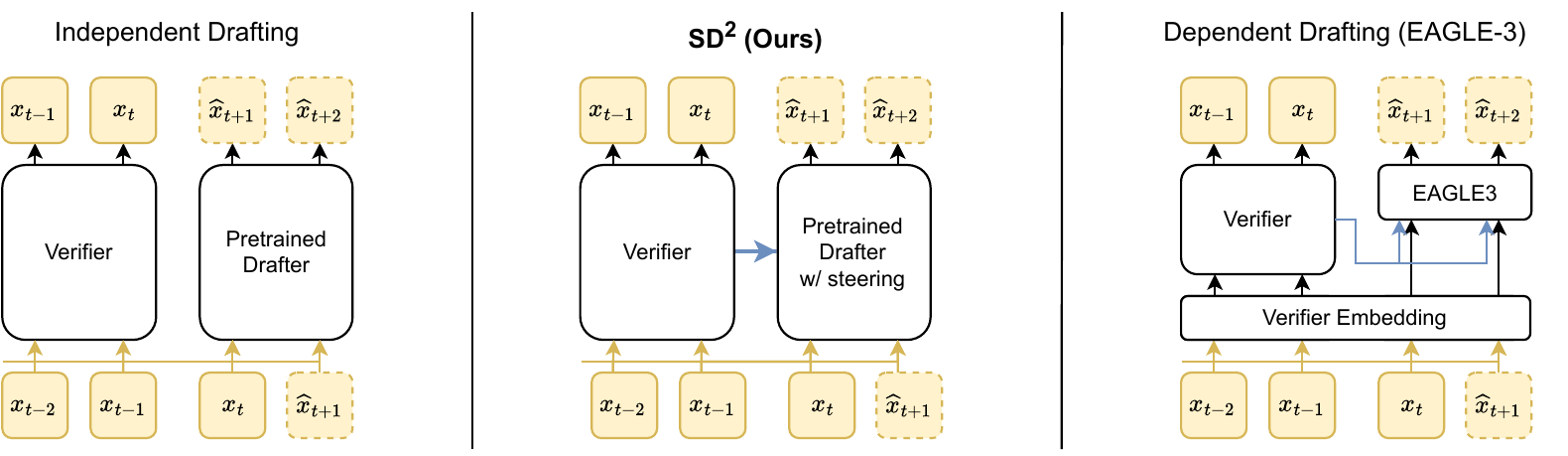
Speculative decoding accelerates LLM inference by having a lightweight drafter propose tokens that are then verified in parallel by the larger model. The main bottleneck is drafter-verifier misalignment: the more the drafter’s predictions diverge from the verifier’s, the more tokens get rejected.
Pretrained drafters generalize well but lack dynamic alignment with the verifier. Dependent drafters (trained from scratch on verifier hidden states) are fast but brittle outside their training distribution. SD2 bridges this gap by introducing a lightweight steering mechanism that extracts predictive signals from the verifier’s hidden states and injects them into the pretrained drafter at inference time.
How it works
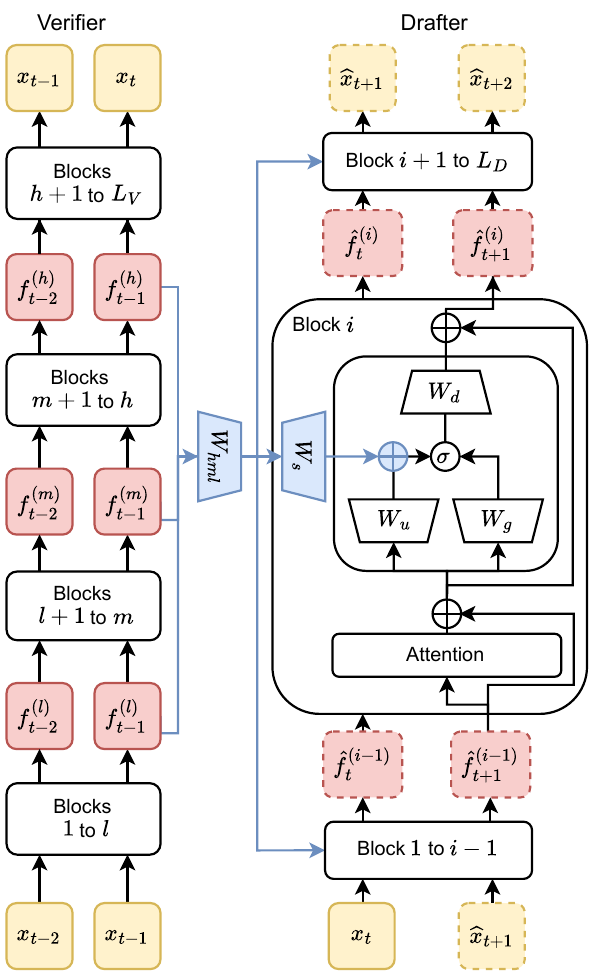
The method has three components:
- Steering vector extraction: After verification, the verifier’s hidden states at the last accepted position are concatenated across three layers (high, mid, low) and linearly projected into a compact steering vector.
- Bias injection: The steering vector is mapped through a second linear layer into per-layer biases, which are added inside the drafter’s SwiGLU MLP (before the gating activation) at every layer.
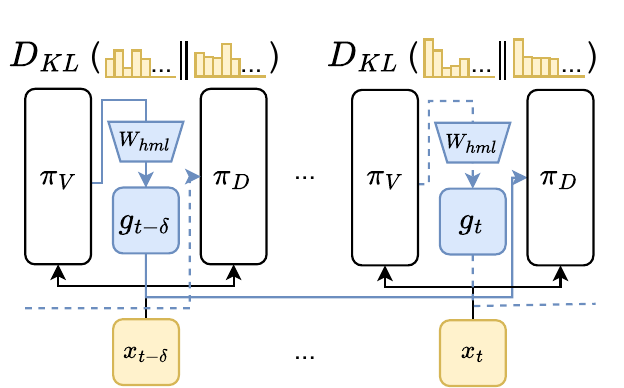
- Training: The steering parameters and the drafter are jointly fine-tuned using KL divergence against the verifier’s token distribution, with a random offset to simulate all drafting positions uniformly.
Results
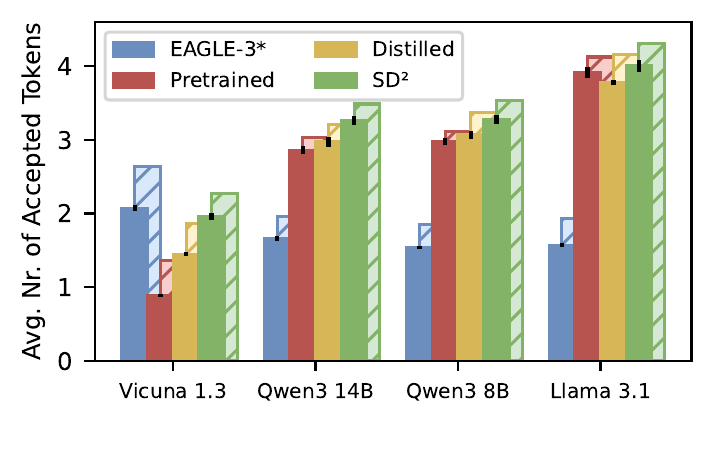
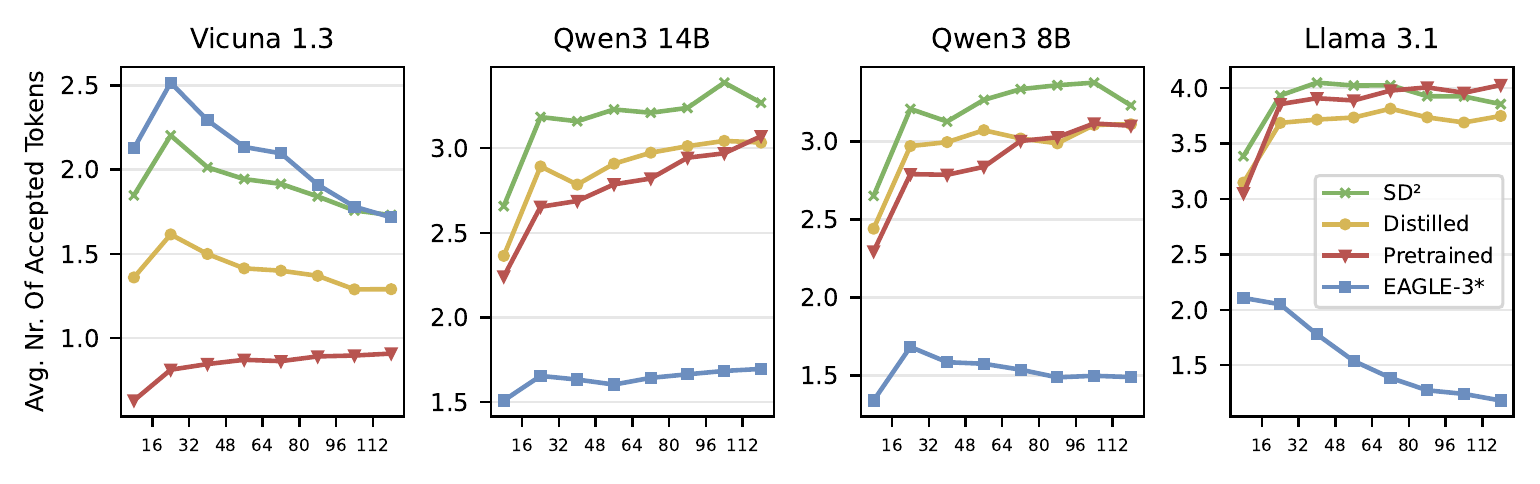
SD2 is evaluated across four verifier-drafter pairs (Vicuna 1.3 13B / Llama 160M, Qwen3 14B / Qwen3 0.6B, Qwen3 8B / Qwen3 0.6B, Llama 3.1 8B / Llama 3.2 1B) on five benchmarks (UltraChat, HumanEval, XSum, Alpaca, GSM8K).
Key numbers
- Up to +35% more accepted tokens under standard sampling and +22% under greedy sampling compared to pretrained drafters.
- Up to +83% speedup on in-distribution data (Vicuna 1.3), and +61% average speedup across all tasks for that pair.
- SD2 consistently outperforms distillation, achieving roughly twice the additive speedup under standard sampling.
- On out-of-distribution tasks (GSM8K, HumanEval), SD2 matches or exceeds pretrained drafter performance, while distillation often degrades.
Long-sequence robustness
Ablations
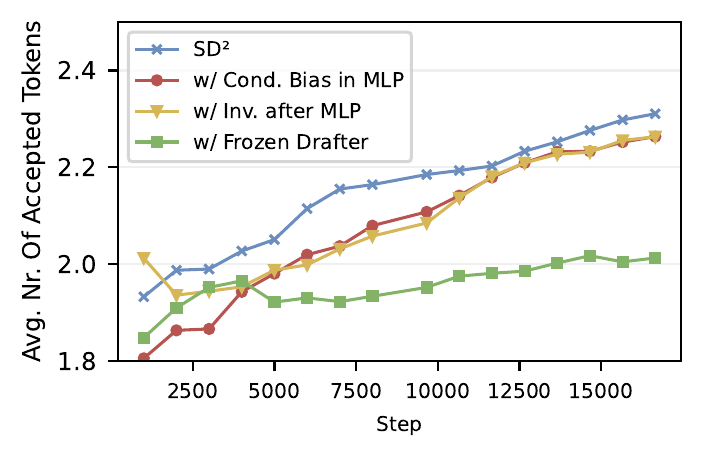
The ablation studies justify two key design choices:
- Steering mechanism: Adding the bias inside the SwiGLU (before gating) outperforms simpler post-MLP injection and more complex conditional variants.
- Drafter fine-tuning: Unfreezing the drafter during training yields consistently better results, though steering alone already doubles accepted tokens over the pretrained baseline.
Code
The implementation is available on GitHub: ETH-DISCO/SD-square.
Citation
Berdoz, F., Rheinboldt, P., & Wattenhofer, R. (2026). Steering Pretrained Drafters During Speculative Decoding. Proceedings of the AAAI Conference on Artificial Intelligence, 40(36), 30067-30075. https://doi.org/10.1609/aaai.v40i36.40255